


Safety-first answer: A pressure care cushion can redistribute load, improve immersion or support posture, but it cannot remove all pressure or replace movement, skin checks and a clinical plan. Choose the cushion with an occupational therapist, physiotherapist, seating clinician or wound-care professional when pressure-injury risk, skin changes or complex posture are present.
“Pressure relief” is often used as a broad retail term. In practice, cushions differ in materials, contour, adjustability, maintenance and clinical purpose. A comfortable cushion is not automatically effective for a particular risk profile, and a high-specification cushion can perform poorly when it is the wrong size or used incorrectly.
Pressure redistribution is only one part of care
Pressure injuries can involve pressure together with shear, friction, heat, moisture, reduced sensation and limited ability to reposition. The Australian Commission on Safety and Quality in Health Care emphasises screening, assessment, prevention, monitoring and appropriate equipment. A cushion belongs inside that broader plan.
Seek prompt clinical review for persistent redness or discolouration, warmth, swelling, broken skin, new pain or a change in sitting tolerance. Do not wait for a product change alone to solve a skin problem.
Common cushion constructions
| Type | Typical characteristics | Important checks |
|---|---|---|
| Foam | Stable, shaped or layered; low daily adjustment | Compression, bottoming out, heat and correct contour |
| Air | Immersion and adjustability depending on design | Inflation, leaks, valve care and daily setup |
| Fluid or gel | Conforms around bony areas; often combined with foam | Fluid migration, weight, temperature and correct orientation |
| Hybrid | Combines foam with air or fluid components | Each component’s setup and maintenance requirements |
These categories overlap. Product documentation and clinical performance matter more than the material name.

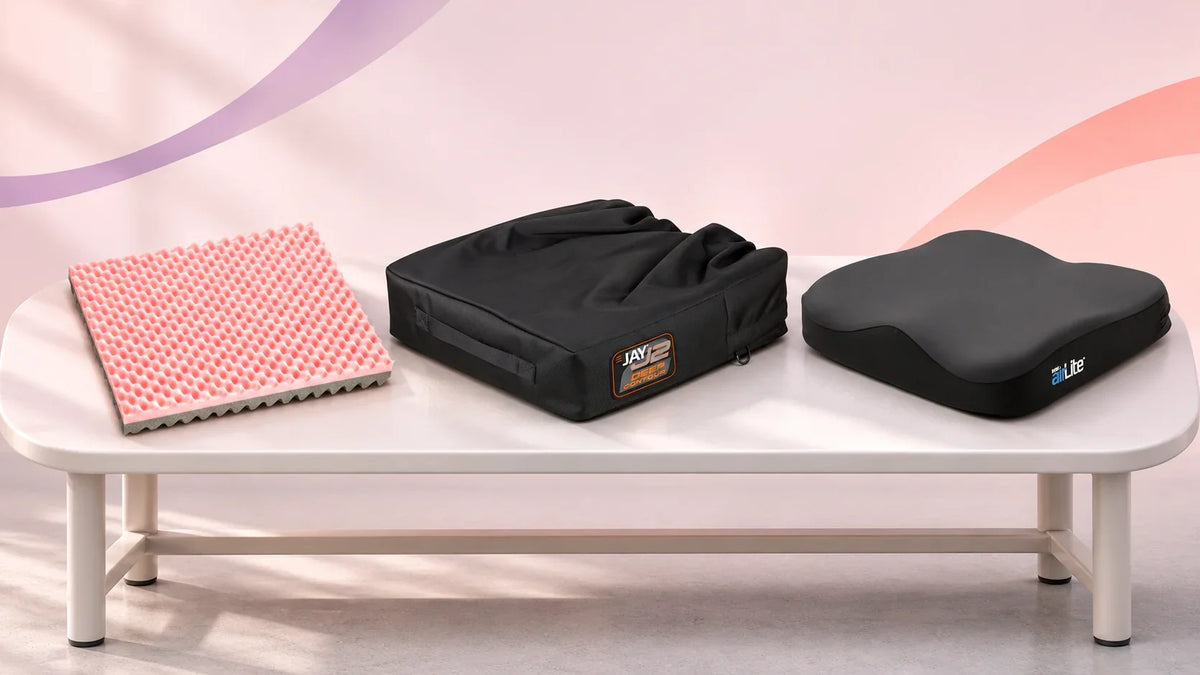
Foam, fluid and hybrid designs differ in contour, stability, setup and maintenance.
Start with the person, not the cushion
Assessment considers skin history, sensation, body shape, posture, pelvic position, ability to weight shift, continence, temperature, sitting time and the activities performed in the chair. The same cushion can behave differently under two people with different posture or movement.
Queensland Spinal Cord Injuries Service notes that incorrect seat dimensions can affect the thighs, hips and tendency to slide. A cushion cannot compensate for every wheelchair or chair configuration problem.
Width and depth must match the seating surface
The cushion should fit the chair without curling at the sides, leaving a gap or projecting dangerously beyond the seat. It should also fit the person and support the thighs without pressing behind the knees. Check that added cushion height does not make armrests, footplates or transfer surfaces unsuitable.
Measure the usable seat platform and follow the manufacturer’s sizing method. Do not select only by the user’s clothing size or the chair’s nominal width.
Orientation and cover matter
Many contoured cushions have a clear front, rear, top and bottom. A reversed cushion can change pelvic position and load distribution. Use the supplied cover and ensure zips, labels or seams do not create a pressure point. Fluid-resistant covers assist hygiene but can change heat and moisture management.
Product examples show different design approaches
The SAF Pink/Grey Cushion uses dual-density foam with a gel-permeated upper layer and firmer base. The live listing offers several sizes, a 60 mm height and optional fluid-resistant covers, with a published 110 kg maximum user weight.
The JAY J2 Deep Contour Cushion uses a pre-contoured foam base with a JAY Flow fluid pad and is intended for more complex skin and postural needs. Its current AATC listing includes 18 × 16 and 18 × 18 inch variants.
The ROHO AirLITE Cushion combines an air pad with a contoured foam base and offers a broad size range. Its listing specifies a fluid-resistant washable cover and a 113 kg maximum weight capacity.
These examples are not interchangeable recommendations. A clinician should match the product to the risk, posture, chair and care routine.

Correct size, orientation, cover condition and regular inspection are essential.
Daily and regular checks
- Confirm the cushion is correctly oriented and centred before sitting.
- Check air pressure or inserts as required by the manufacturer.
- Inspect the cover for moisture, wrinkles, tears and contamination.
- Check foam for permanent compression and fluid or air components for damage.
- Follow the prescribed skin-check and repositioning plan.
- Wash covers only according to the care instructions and ensure everything is dry before use.
Questions to ask a clinician
- What is the person’s current pressure-injury and shear risk?
- Does the cushion need to correct or accommodate posture?
- Can the user perform pressure shifts, and what plan is appropriate?
- What cushion size and height work with the chair and foot supports?
- Who will check setup, skin and maintenance?
- How will the cushion be reviewed if weight, posture, skin or equipment changes?
Frequently asked questions
Is memory foam a pressure care cushion?
Material alone does not define clinical suitability. Foam density, contour, thickness, cover, user risk and chair setup all matter.
Is an air cushion always better?
No. Air designs can provide excellent immersion but may require setup and monitoring. Some users need the stability of foam or a hybrid design.
Can I add a pressure cushion on top of an existing cushion?
Do not stack cushions unless the manufacturer and clinician approve it. Stacking changes height, stability and posture.
Does a cushion remove the need to reposition?
No. Pressure-redistributing equipment does not remove all pressure. Follow the individual repositioning and skin-care plan.
Next step: Browse AATC’s pressure care cushions, record the chair dimensions and current skin/posture needs, then involve the relevant clinician before selecting a higher-risk product.
Sources and further reading
- Australian Commission on Safety and Quality in Health Care: preventing pressure injuries
- Australian Commission: Comprehensive Care Standard
- Queensland Spinal Cord Injuries Service: skin considerations for seating
This article is general education, not a pressure-injury risk assessment, prescription or treatment plan. Clinical review is required before publication and before selecting equipment for a person at risk.