


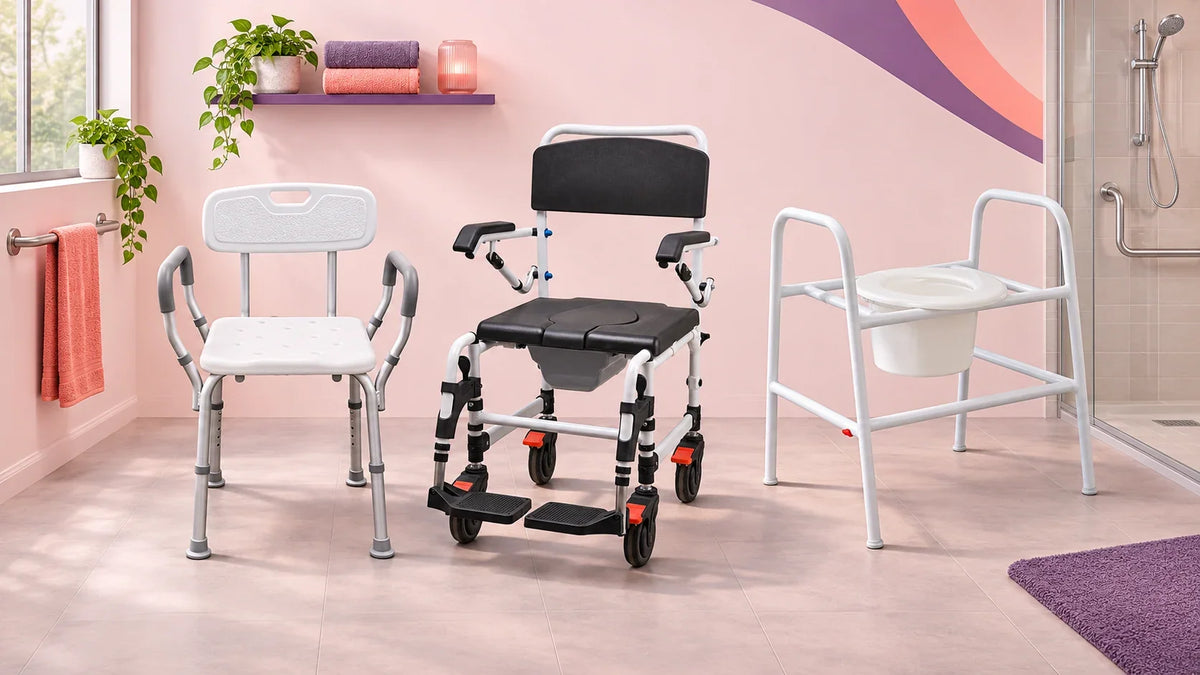
Quick answer: A shower chair provides seated support for washing. A commode chair provides toileting away from—or sometimes over—a toilet, depending on its design. An over-toilet aid sits around an existing toilet to raise the seat and add arm support. Similar-looking frames are not interchangeable unless the manufacturer specifically approves those uses.
| Equipment | Primary purpose | Typical setup | Key check |
|---|---|---|---|
| Shower chair | Seated showering | Static, water-resistant chair on a level shower floor | Wet-area stability and transfer access |
| Commode chair | Toileting away from the bathroom or over a toilet if designed for it | Seat with aperture and removable pan | Pan, aperture, hygiene and transfer method |
| Over-toilet aid | Raise the toilet and provide arms | Frame positioned around an existing toilet | Clearance, seat alignment and stable feet |
| Mobile shower commode | Combined showering, toileting and bathroom movement | Wheeled chair with brakes and foot support | Clinical fit, brakes, posture and carer method |
Shower chairs are designed for seated washing
A static shower chair is made to stand on the shower floor and resist wet-area conditions. It may have a backrest, armrests and height-adjustable legs. It does not normally include a toileting aperture or pan and should not be assumed to fit over a toilet.
Commode chairs bring toileting closer
A bedside or static commode provides a toileting seat and removable pan where bathroom access is difficult. Some “three-in-one” models can also be positioned over a toilet or used as a toilet surround, but only when the product instructions say so. A standard bedside commode is not automatically shower-safe.
Check the pan can be removed and cleaned without unsafe lifting or contact. The lid, splash guard and aperture must work with the user’s posture and hygiene routine.
Over-toilet aids work with the existing toilet
An over-toilet frame raises the sitting surface and provides arms for transfers. It needs enough clearance around the toilet bowl, cistern, plumbing and nearby walls. The seat aperture must align with the toilet, and every foot must stand securely on the floor.
Raising the seat can reduce the effort of standing, but too much height can leave the feet unsupported or make positioning difficult. Check usable width between the arms as well as overall width.

Similar frames can have different approved uses: showering, bedside toileting or over-toilet support.
Mobile shower commodes are a separate clinical category
A mobile shower commode can allow a person to remain seated while moving between shower and toilet areas. Queensland Health guidance notes that these chairs use wheels, brakes and footplates and may require assistance for transfers and positioning. Brakes should be applied for transfers and showering, all wheels must be on an even surface and the feet need appropriate support.
Self-propelled, attendant-propelled and tilt-in-space versions have different demands. These products warrant individual assessment, especially when used for hoist transfers, complex posture or prolonged personal care.
Seat apertures affect comfort, skin and hygiene
Queensland Spinal Cord Injuries Service warns that aperture size, padding, posture and reduced seating surface can affect pressure, friction and shear. The user should not sit on a hard internal rim or slide forward into an oversized opening. Inspect padded seats for cracks, exposed base material, compressed foam and damaged seams.
Compare the complete transfer
- Where does the person start and finish?
- Can a walking aid, transfer board or hoist be positioned safely?
- Are armrests fixed, removable or swing-away?
- Can the user’s feet be supported during sitting and movement?
- Is there enough space for a carer without twisting or reaching?
- Can the equipment be cleaned and dried after every use?

Plan for the transfer, foot support, brakes, toilet alignment and carer space.
Product examples from AATC
The SMIK Aluminium Shower Chair with Arms is a static wet-area chair with back and arm support. The Black Aluminium Commode Chair with Flipped Armrest includes a toileting aperture and pan for commode use. The Care Quip Extra Wide Over Toilet Aid is positioned around an existing toilet and is offered in multiple widths. These products answer different needs despite sharing frame-and-seat features.
Decision checklist
- Define whether the main task is showering, bedside toileting, using the toilet or combining tasks.
- Measure doorways, toilet clearance, shower floor and carer working space.
- Check seat height, width between arms, depth, aperture and safe working load.
- Confirm whether the frame is approved for water, over-toilet use or mobile use.
- Trial the exact transfer with the usual footwear, aids and assistance.
- Confirm cleaning, pan handling, brake use and maintenance procedures.
Frequently asked questions
Can a shower chair be used over a toilet?
Only if the manufacturer explicitly designs and approves it for that use. A standard shower chair usually has no toileting aperture.
Is a commode chair waterproof?
Not necessarily. A bedside commode may not be approved for shower use. Check materials and instructions.
What is a three-in-one commode?
It is typically designed for bedside commode use, over-toilet use and toilet-surround support. Functions vary, so check the exact model.
When is a mobile shower commode considered?
It may be useful when a person needs to remain seated between transfer, shower and toilet tasks. Clinical assessment is strongly recommended.
Next step: Explore AATC’s shower seating, shower commodes and broader bathroom aids, then compare the actual dimensions with the bathroom and transfer plan.
Sources and further reading
- Queensland Health: Mobile shower commode fact sheet
- Queensland Spinal Cord Injuries Service: skin considerations when showering and toileting
- Queensland Health: Static Bathing and Toileting Aids
This article provides general information and does not replace an individual bathroom, skin, seating or transfer assessment.