


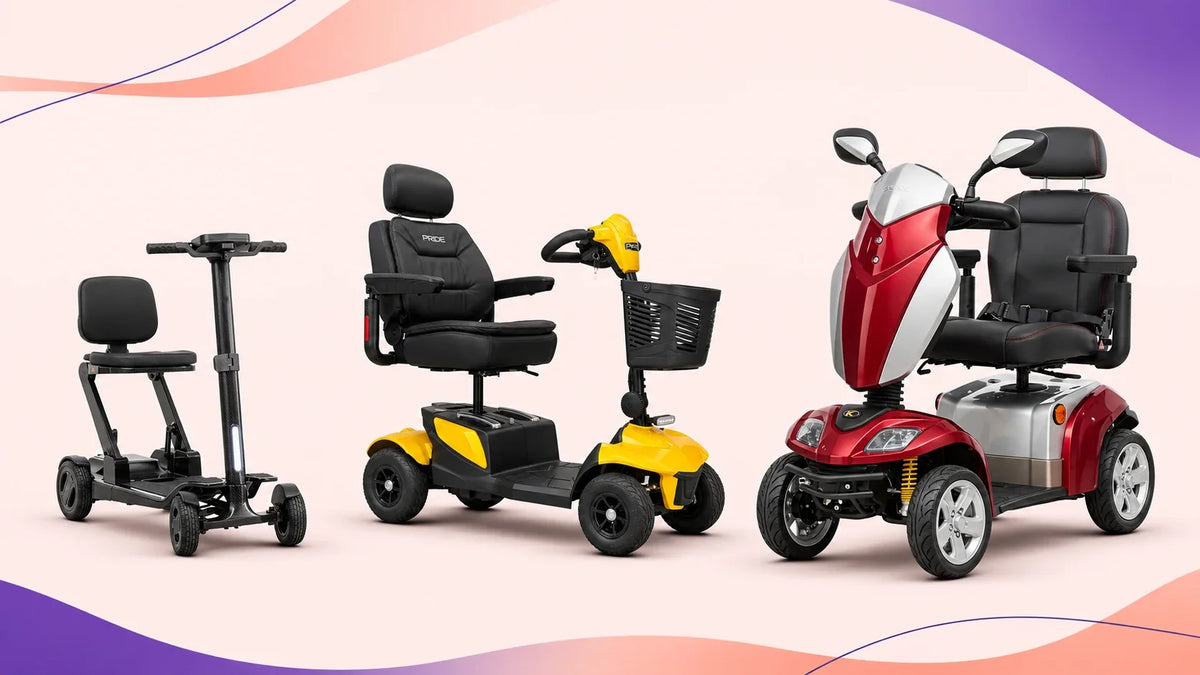
Choosing a mobility scooter is easier when you begin with your everyday trips rather than a brand or model. Where will you use it? How far do you normally travel? Will it need to fit into a car? What surfaces, slopes and tight spaces are part of the route?
Quick answer: start by defining the scooter’s normal environment, transport and storage requirements. Then compare physical fit, weight capacity, range, turning radius, ground clearance, tyres, suspension and battery arrangements. A specification only matters when it matches the way the scooter will actually be used.
This guide explains the main decisions to make before comparing individual models in the AATC mobility scooter range.
Start with the trip, not the scooter
Write down the trips the scooter needs to support during a normal week. This creates a clearer brief than starting with a list of features.
- Will it mainly be used in shopping centres or on smooth indoor surfaces?
- Will it travel along local footpaths for errands and appointments?
- Are there uneven paths, grass, gravel, kerbs or steep driveways on the route?
- How far is a typical return trip?
- Does the scooter need to travel in a car, caravan or on public transport?
- Where will it be stored and charged?
- What is the narrowest doorway, gate, lift or storage space it must pass through?
One scooter may not optimise every situation. A lightweight folding model can make car transport easier, while a larger scooter may provide more range, ground clearance, suspension and seating comfort. The right shortlist depends on which trade-offs matter most.
First check whether a mobility scooter is the right type of device
A mobility scooter generally requires the user to transfer onto the seat, maintain a suitable seated position, reach and operate the tiller, turn to check the surrounding environment and respond safely to hazards.
A powered wheelchair may be worth considering when indoor manoeuvrability, postural support, pressure management or alternative controls are central requirements. The electric wheelchair range provides a useful comparison point.
If there is uncertainty about transfers, vision, concentration, posture, pain, pressure care or the ability to use the controls consistently, seek advice from an occupational therapist or another suitably qualified health professional. Transport Victoria’s guidance also recommends considering the user’s physical and cognitive ability before purchasing a motorised mobility device.
Understand the main types of mobility scooters
Retailers and manufacturers do not always use category names in exactly the same way, but most models can be considered in three broad groups.
| Category | Often considered for | What to check carefully |
|---|---|---|
| Portable or folding | Car travel, appointments, shopping centres and storage in smaller spaces | Total weight, heaviest lift, folded dimensions, range, ground clearance, seat size and suspension |
| Everyday or mid-size | Local errands, community access and a balance of comfort and manoeuvrability | Transport method, turning radius, battery size, seat adjustment and the surfaces on the normal route |
| Larger or heavy-duty | Longer outdoor trips, higher user-weight requirements and more varied surfaces | Storage, charging, vehicle transport, overall dimensions, total weight and access through gates or lifts |
Portable and folding mobility scooters
Portable mobility scooters may fold as one unit or separate into several pieces. Do not rely on the word “portable” alone. Check:
- the total scooter weight
- the battery weight
- the heaviest piece after disassembly
- the folded dimensions
- whether the battery must be removed before lifting
- whether the person loading it can safely manage the required lift
A one-piece folding scooter can be quick to set up but may still require the full frame to be lifted. A scooter that separates can involve more steps while reducing the weight of the heaviest individual section.

Everyday or mid-size mobility scooters
Mid-size scooters often balance manoeuvrability, seating comfort, range and outdoor capability. They may include suspension, pneumatic tyres, adjustable tillers and larger seats while remaining smaller than full-size outdoor models.
Some can be separated for transport, but the heaviest section may still be substantial. Measure the vehicle and check the lifting requirement before treating a disassembling scooter as car portable.
Larger and heavy-duty mobility scooters
Heavy-duty mobility scooters can offer higher capacities, larger batteries, bigger wheels and more substantial seating. Those benefits usually come with greater overall weight, a wider turning circle and more demanding storage and transport requirements.
Check that the complete route, including home access, gates, lifts, footpaths and destinations, can accommodate the scooter’s dimensions.
Three wheels or four wheels?
Three-wheel scooters commonly offer a tighter turning circle and additional legroom around the front of the deck. This can be useful in tighter spaces.
Four-wheel scooters have a broader wheel layout and are commonly considered for outdoor routes and users who prioritise a stable footprint. They usually require more room to turn.
Wheel count is only one part of the decision. Overall dimensions, turning radius, speed, tyres, suspension, terrain, user position and manufacturer limits all affect how a scooter behaves. A separate comparison is more useful than assuming every three-wheel or four-wheel scooter has the same characteristics.

Check physical fit, transfers and controls
A scooter can meet the required range and still be unsuitable if the seat, transfer position or controls do not fit the user.
Weight capacity
Compare the manufacturer’s maximum user-weight capacity with the complete load the scooter is expected to carry. Consider any relevant personal items or equipment. A published maximum is a limit; it does not prove that the seat dimensions or driving position will be comfortable.
Seat dimensions and transfer position
Review seat width, seat depth and seat height. A swivel seat, moving armrests and an adjustable seat position may make transfers easier for some users. The seat should also provide an appropriate driving position without forcing the user to stretch for the tiller.
Tiller and hand controls
Check tiller adjustment, grip shape, control layout and the force required to operate the throttle and brakes. The user needs to steer, slow, stop and reverse consistently while monitoring the environment.
Foot and knee space
Deck length, tiller position and seat adjustment affect legroom. This is particularly important for taller users or anyone with restricted knee or hip movement.
Work out the real transport and storage requirements
Before buying, measure the environment rather than relying on visual estimates.
- Measure the car-boot opening, not just the internal boot volume.
- Measure the narrowest gate, doorway and lift entrance.
- Check the space required to turn into the storage area.
- Confirm that dry, secure storage and a suitable charging point are available.
- Check whether a ramp, hoist or vehicle modification would be required.
- Confirm the heaviest piece that must actually be lifted.
For public transport, check the current operator requirements for dimensions, manoeuvrability and access before choosing a model.
Learn what the main specifications mean
Range per charge
Manufacturer range figures are maximum test values, not guaranteed everyday travel distances. Real range can be affected by user and load weight, hills, surface type, temperature, battery condition, tyre condition, repeated starts and stops and how the scooter is driven.
Choose a model with a practical buffer beyond the normal return trip. Planning to use the entire published maximum leaves little allowance for changing conditions or battery ageing.
Maximum speed
A higher top speed does not automatically make a scooter more suitable. Control, route conditions and local rules matter more. Requirements vary between states and territories, so check the relevant transport authority.
In NSW, qualifying mobility-scooter users are treated as pedestrians under the road rules. Devices used on footpaths must not be capable of travelling faster than 10 km/h, and users must follow pedestrian rules. Always confirm current requirements for the state or territory where the scooter will be used.
Turning radius and overall dimensions
Overall width determines whether the scooter can pass through an opening. Turning radius indicates the space it needs to turn. Both matter for shop aisles, lifts, hallways, gates and storage areas.
A compact width does not always mean a tight turning circle, so compare the two specifications separately.
Ground clearance, tyres and suspension
Smaller solid tyres and low ground clearance are commonly found on lightweight travel models intended for smoother surfaces. Larger tyres, additional clearance and suspension can improve comfort and capability on varied outdoor routes.
No specification makes a scooter suitable for every surface. Follow the manufacturer’s terrain, obstacle and incline limits.
Incline capability
Only use manufacturer-published incline limits. Real performance is also affected by load, battery condition, surface grip and the way the slope is approached. Do not use a scooter beyond its specified limits.
Battery and charging
Compare battery chemistry, capacity, removability, charger type and the location of the charging port. If the scooter will be stored away from a power point, check whether the battery can be removed and charged separately.
For replacement batteries and compatible charging options, see the mobility scooter battery collection. Airline transport requires separate confirmation from the airline using the current battery documentation for the exact model.
Examples of different trade-offs in the AATC range
The examples below are not a ranking. They show how different specifications support different priorities. Specifications should be checked again on the live product page and current manufacturer document before purchase.
| Example | Trade-off illustrated | Selected specifications |
|---|---|---|
| Pride Go Go Carbon | Very light folding transport with a shorter maximum range, low ground clearance and no suspension | Four wheels; up to 16 km range; 136 kg capacity; 16 kg excluding the 1.8 kg battery; 44 cm wide; 134.6 cm turning radius |
| Pride Gopher Eco | Everyday comfort and longer range in a scooter that separates for transport but requires a heavier lift | Four wheels; up to 36 km range; 150 kg capacity; 23.6 kg heaviest section; 56 cm wide; front and rear suspension |
| Kymco Agility | Longer-range outdoor specification with substantially greater total weight and storage requirements | Up to 40 km range; 165 kg capacity; 107 kg including batteries; 10 km/h; 10 cm ground clearance; 156 cm turning radius |
| Solax Transformer Comfort Pro | Automatic folding and moderate transport weight with a shorter maximum range | Up to 15 km range; 125 kg capacity; 27.55 kg excluding the 1.7 kg battery; 139.7 cm turning radius; 4.5 cm ground clearance |
The lightest scooter in the table is not automatically the right choice, and the model with the longest published range is not automatically better. The relevant question is which set of trade-offs fits the intended trips, user and environment.
Build a shortlist before comparing prices
Use this checklist to turn everyday needs into comparable specifications:
- Normal return-trip distance: ______
- Required range with a practical buffer: ______
- Surfaces, slopes and obstacles: ______
- User weight and relevant carried items: ______
- Seat and transfer requirements: ______
- Maximum scooter width: ______
- Available turning space: ______
- Car-boot opening and internal dimensions: ______
- Maximum safe lifting weight: ______
- Storage and charging location: ______
- Required tyre or suspension features: ______
- Required documents for funding or travel: ______
Once those fields are defined, compare only the scooters that satisfy the non-negotiable requirements.
Questions to ask before buying
- Is the quoted range a maximum figure, and what conditions affect it?
- What is the heaviest piece I need to lift?
- Does the battery come out before lifting or folding?
- Will the scooter fit through my narrowest gate, doorway or lift?
- What surfaces and incline limits does the manufacturer specify?
- Can I sit, transfer and operate the controls comfortably?
- What warranty, servicing and replacement-battery support is available?
- Which manual, safety and battery documents are supplied?
Frequently asked questions
What size mobility scooter do I need?
Choose dimensions by measuring the user and the places the scooter must access. Check seat dimensions, weight capacity, overall width, turning radius, storage space and the vehicle opening if it will be transported. “Small”, “medium” and “large” are not enough on their own.
Is a three-wheel or four-wheel mobility scooter better?
Neither layout is universally better. Three-wheel scooters commonly turn in less space and may provide more legroom. Four-wheel scooters are commonly considered when a broader footprint is preferred. Compare the exact model, environment and user requirements.
How much range do I need?
Start with the longest normal return trip and add a practical buffer. Do not plan regular trips at the full published maximum because load, hills, surface, weather and battery condition can reduce real-world range.
Can a mobility scooter fit in a car boot?
Some scooters fold, while others separate into sections. Measure the boot opening and internal space, then compare folded dimensions and the heaviest piece. Check who will lift it and whether a ramp or hoist is required.
Should I choose a mobility scooter or a powered wheelchair?
A scooter may suit someone who can transfer, sit in the scooter seat and operate a tiller safely. A powered wheelchair may be more appropriate when indoor manoeuvrability, specialised seating, pressure care or alternative controls are required. Seek professional assessment when the choice is not clear.
Can I take a mobility scooter on a plane?
Possibly, but acceptance depends on the exact scooter, battery specifications and airline policy. Obtain the current battery and compliance documents and confirm the arrangements directly with the airline before travel. Do not rely on a general “airline approved” label.
Compare scooters after defining the requirements
A useful shortlist begins with the person, the trip and the environment. Define the non-negotiable dimensions and capabilities first, then compare comfort, features and price among the models that meet them.
Explore mobility scooters at AATC, compare portable models, or contact the AATC team if you need help narrowing the available options.