


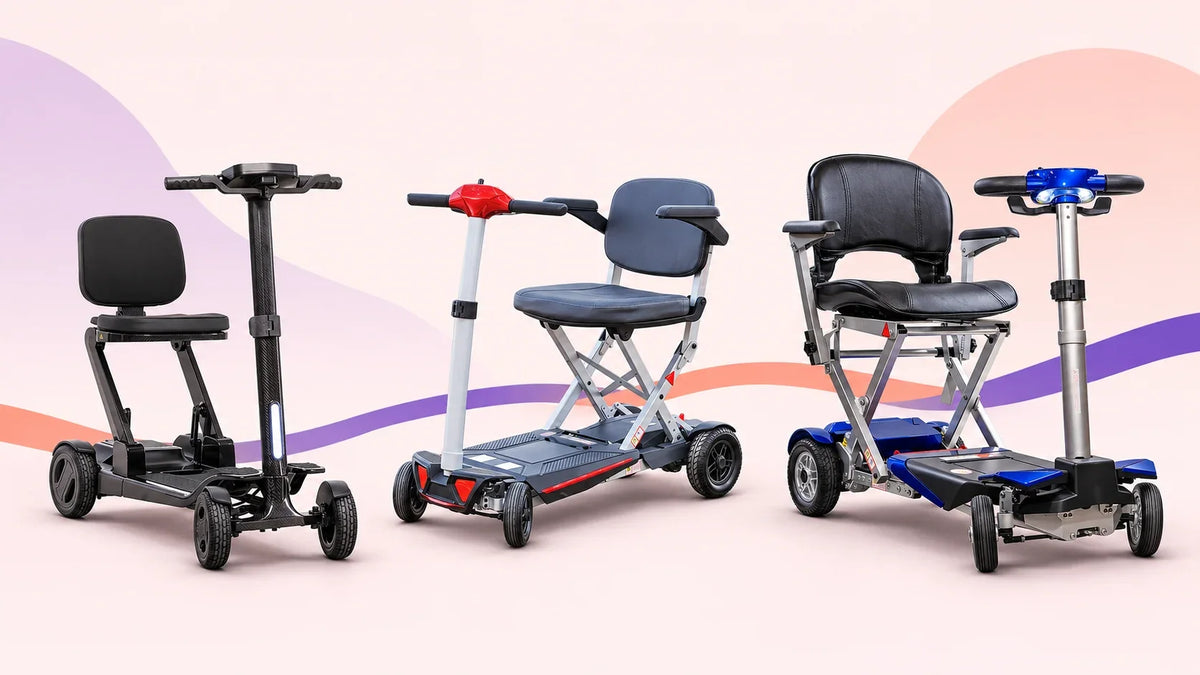
A portable mobility scooter can make car travel, appointments and storage easier, but the word “portable” does not tell you what must be lifted, how the scooter folds or whether it will fit in a particular vehicle.
Quick answer: compare four measurements before anything else: total scooter weight, battery weight, the heaviest piece you must lift and the folded or dismantled dimensions. Then check the setup steps, seat fit, range, ground clearance, tyres, suspension and battery arrangements against the way the scooter will actually be used.
Use this guide while comparing the portable mobility scooters available from AATC. It explains the trade-offs rather than naming one model as the best choice for everyone.
What does “portable mobility scooter” mean?
Portable is a broad retail category rather than one fixed design standard. A scooter may be described as portable because it:
- folds manually as one main unit
- folds automatically using a button or remote control
- separates into several smaller pieces
- has a removable battery that reduces the lifting weight
- is compact enough for selected car boots or storage areas
Two portable scooters can therefore require very different loading methods. A one-piece folding model may have fewer setup steps but require a heavier single lift. A dismantling scooter may have a higher total weight while reducing the weight of the heaviest individual section.
Folding, automatic folding or dismantling?
| Format | Potential advantage | What to check |
|---|---|---|
| Manual folding | Usually one main unit with a direct folding process | Force and hand movement needed to fold it, total lift, locking points and folded dimensions |
| Automatic folding | Motorised folding can reduce the physical effort involved in the folding action | Total lift, time to fold, battery state, manual backup process and space needed while it folds |
| Dismantling | Can reduce the heaviest individual lift | Number of pieces, heaviest piece, reconnection steps, battery handling and space for every component |
Automatic folding does not make a scooter automatically light. Dismantling does not make it automatically easy to assemble. Test the complete process the same way it will be performed at home or beside the vehicle.

Portable formats involve different trade-offs between one-piece folding, overall weight and the number of setup steps.
The four portability measurements to record
1. Total scooter weight
Total weight helps with vehicle loading limits, ramps, hoists and handling the complete scooter. Check whether the published number includes the battery, seat, armrests and accessories.
2. Battery weight
A removable battery can reduce the weight of the scooter during loading. It also creates a separate item that must be carried, protected and reconnected. Confirm whether the battery can be charged on and off the scooter.
3. Heaviest piece
This is often the most useful lifting number for a dismantling scooter. A model may be heavier overall but separate into a main section that is lighter than a one-piece folding frame.
4. Folded or dismantled dimensions
Measure the scooter in the exact state in which it will travel. Include components that project beyond the frame, such as wheels, tiller, seat or armrests. A product photo is not a reliable measurement.
Write these four numbers beside every scooter on the shortlist. If a product page does not clearly identify them, obtain the current manufacturer document before purchase.
Measure the vehicle before choosing the scooter
Boot volume alone is not enough. The opening can be smaller than the internal storage space, and the loading angle can require additional clearance.
- Measure the boot opening at its narrowest width and height.
- Measure the usable depth with the seats in their normal position.
- Check the height of the loading lip.
- Allow space for every dismantled part and the charger.
- Identify where the person loading the scooter can stand.
- Check whether the scooter can be lifted without twisting or reaching into the boot.
- Confirm whether a ramp, hoist or vehicle modification is required.
Try the loading sequence before purchase where possible. A scooter that technically fits may still be impractical if it must be rotated in mid-air or lifted over a high boot lip.

Measure the boot opening, loading lip and storage area, then test the complete loading sequence with the intended scooter.
Confirm who will load and assemble it
Do not assume a support person will always be present. Identify who will fold, lift, dismantle, load and rebuild the scooter during a normal trip.
The process may require:
- bending to release a latch
- holding the scooter steady while it folds
- lifting a frame from floor level
- aligning electrical connectors
- removing or fitting a battery
- checking that the frame and seat have locked correctly
If strength, balance, pain, grip or safe lifting is uncertain, seek appropriate advice and consider a loading aid. “Portable” should describe a process the relevant person can perform safely and consistently.
Check comfort, transfers and driving position
Reducing weight and folded size can affect seat dimensions, padding, armrests, suspension and adjustability. A portable scooter still needs to fit the person for the duration of the intended trip.
- Compare seat width and depth, not only maximum weight capacity.
- Check seat-to-deck height and available knee space.
- Confirm whether armrests are supplied, adjustable or removable.
- Check the tiller height and angle.
- Practise the transfer and confirm the frame remains secure.
- Check the grip and force needed for throttle and braking controls.
A very light scooter may suit shorter trips and frequent transport while a heavier dismantling model may provide a larger seat or different ride characteristics. The right trade-off depends on the user and the trip.
Range, wheels, clearance and suspension
Portable scooters commonly use smaller wheels and a compact frame. Some have solid puncture-resistant tyres and no suspension; others include suspension or larger wheels. These differences affect comfort and the types of surfaces the scooter is intended to use.
Check:
- published range per charge
- ground clearance at the lowest point
- front and rear tyre sizes
- solid or pneumatic tyres
- front, rear or no suspension
- manufacturer limits for slopes and obstacles
Published range is a maximum test figure rather than a guaranteed everyday distance. Load, hills, surface, temperature, tyre condition, repeated starts and battery age can reduce real-world range. Plan a practical buffer beyond the normal return trip.
Battery and charging questions
Portable scooters often use removable lithium batteries, but battery type and capacity vary. Record the exact voltage, amp-hour rating and watt-hour rating shown in the current product documentation.
- Can the battery be removed without tools?
- Can it be charged separately from the scooter?
- How much does it weigh?
- Where is the charging port?
- Can the charger be stored safely in the vehicle?
- What replacement battery and service support is available?
For replacement options, see the mobility scooter battery collection. Only use a battery and charger approved for the exact scooter.
Can a folding mobility scooter go on a plane?
Possibly, but a folding frame does not by itself make a scooter acceptable for air travel. The airline needs information about the complete mobility aid and its battery.
The Civil Aviation Safety Authority advises travellers with battery-powered mobility aids to contact the airline before the flight. Requirements can depend on battery chemistry, watt-hour rating, whether the battery is removable, how terminals are protected and how the scooter is secured against accidental activation.
Before booking or travelling:
- obtain the current battery specification and safety documentation
- record the scooter’s dimensions and weight
- tell the airline that it is a mobility aid, not ordinary luggage
- ask how and when approval must be requested
- confirm whether the battery stays installed or must be removed
- ask how removable and spare batteries must be packed
- carry the airline’s written instructions and manufacturer documents
Do not rely on a general “airline approved” or “plane safe” statement. Approval and handling instructions must be confirmed for the exact battery, airline, aircraft and itinerary.
Examples of different portable-scooter trade-offs
The models below illustrate different ways to achieve portability. They are not a ranking. Specifications should be checked again on the live page and in the current manufacturer documentation.
| Example | Portable format | Selected specifications |
|---|---|---|
| Pride Go Go Carbon | One-piece manual folding | 16 kg excluding a 1.8 kg battery; up to 16 km range; 136 kg capacity; 44 cm overall width |
| Solax MobiFree | One-piece manual folding | 20.5 kg without battery and 22.3 kg with battery; up to 15 km range; 125 kg capacity; no suspension |
| Solax Transformer Comfort Pro | Automatic folding | 27.55 kg without a 1.7 kg battery; up to 15 km range; 125 kg capacity; front and rear suspension |
| Pride Go-Go Elite Traveller Plus | Dismantles into five pieces | 35.6 kg without the battery pack, but a 15.88 kg heaviest piece; up to 21 km range; 136 kg capacity |
The comparison shows why total weight alone can be misleading. The Elite Traveller Plus is heavier overall than the one-piece folding examples, but its heaviest dismantled section is lighter than several complete folding frames. The better option depends on whether the user prefers one main lift or several assembly steps.
Portable mobility scooter buying checklist
- Normal return-trip distance: ______
- Required range with buffer: ______
- Surfaces and slopes: ______
- Total scooter weight: ______
- Battery weight: ______
- Heaviest piece: ______
- Folded or dismantled dimensions: ______
- Boot opening and usable space: ______
- Person responsible for loading: ______
- Maximum safe lift: ______
- Seat and transfer requirements: ______
- Storage and charging location: ______
- Battery documents required for travel: ______
Frequently asked questions
What is the lightest type of mobility scooter?
Lightweight one-piece folding scooters can have a lower total weight, especially when the battery is removed. The lightest published number is not automatically the easiest loading method. Check who must lift it and from what position.
Is a folding scooter easier to transport than a dismantling scooter?
A folding scooter usually involves fewer pieces, but it may require lifting most of the frame at once. A dismantling scooter involves more setup but can reduce the heaviest individual lift. Compare the complete loading process.
Will a portable mobility scooter fit in my car boot?
Measure the boot opening, loading lip and usable internal space, then compare them with the scooter’s folded or dismantled dimensions. Allow room for the battery, seat, charger and any removed components.
Do portable mobility scooters have less range?
Many portable models use compact batteries to reduce weight, so their published range can be shorter than that of larger scooters. Range varies by model and can be affected by load, hills, surfaces, temperature and battery condition.
Can I charge the battery away from the scooter?
Some removable batteries support off-board charging, while others must be charged in a specific arrangement. Check the manual and use only the approved charger for the exact battery.
Are folding mobility scooters suitable for uneven ground?
Some are intended mainly for smooth surfaces, while others include suspension or different tyres. Check ground clearance, wheel size, suspension and the manufacturer’s terrain limits. Folding capability does not establish outdoor suitability.
Choose the loading process before choosing the model
A portable scooter is useful only when it fits the person, the trip, the vehicle and the person responsible for handling it. Define the maximum safe lift and available dimensions first, then compare comfort, range and features among the models that meet those constraints.
Browse portable mobility scooters, return to the complete mobility scooter range, or read How to Choose a Mobility Scooter in Australia. You can also contact AATC with your vehicle and storage measurements for help narrowing the shortlist.