


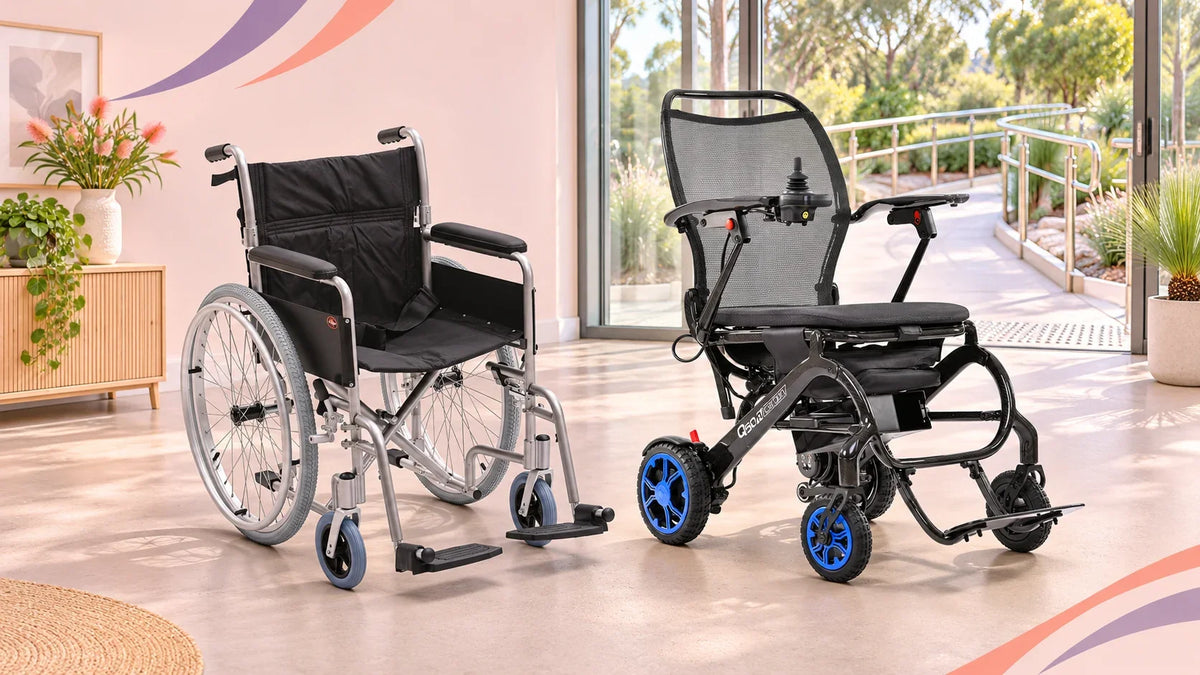
The main difference between a manual wheelchair and an electric wheelchair is how it moves. A manual chair is propelled by the user through the rear handrims, pushed by an attendant, or both. An electric wheelchair uses motors and a battery, usually controlled by a joystick or another compatible control system.
Quick answer: a manual wheelchair may be lighter and simpler to transport, while an electric wheelchair can reduce the physical effort needed to travel and may offer powered seating or specialised controls. The right choice depends on the user’s movement, endurance, posture, transfers, route, transport and available support.
Compare the current manual wheelchairs and electric wheelchairs available from AATC while using this guide to identify the questions that require an individual assessment.
Manual vs electric wheelchairs at a glance
| Decision factor | Manual wheelchair | Electric wheelchair |
|---|---|---|
| Propulsion | User, attendant or both | Battery-powered motors controlled by the user or configured support controls |
| Physical effort | Requires pushing effort from the user or attendant | Can reduce propulsion effort, but still requires reliable control use and safe operation |
| Transport | Many models fold or remove wheels and may be easier to lift | Portable folding models exist, but many powered bases are heavier and may require a ramp, hoist or accessible vehicle |
| Charging | No propulsion battery | Requires battery charging, storage and electrical maintenance |
| Seating options | Ranges from basic folding chairs to custom rigid frames and complex seating | Ranges from portable folding chairs to customised powered bases with tilt, recline or lift |
| Cost and servicing | Usually fewer electrical components | Motors, batteries, controls and powered functions add service requirements |
Neither category is automatically more suitable. A lightweight manual wheelchair can be demanding to self-propel on a slope. A compact power chair can reduce effort but still be difficult to lift into a car. Compare the complete setup and the person’s normal day.

Manual handrims and powered joystick control create different demands for the user.
Start with who will propel the chair
For a manual wheelchair, identify whether the user will self-propel, an attendant will push, or the arrangement will change during the day. Self-propulsion depends on reach, strength, joint movement, grip, endurance, technique and the chair’s setup. Attendant propulsion depends on the supporter’s ability to push, brake, turn and manage slopes or kerbs.
For an electric wheelchair, identify the control method and the environments in which it must work. A standard joystick is not suitable for every user. Control position, sensitivity, programming, cognition, vision and reaction time can all affect safe operation.
Effort, fatigue and distance
A manual wheelchair can support exercise and direct control for a suitable user, but repeated pushing places demands on the shoulders, elbows, wrists and hands. Carpet, hills, crossfalls and long distances increase the effort. The chair’s weight, rear-wheel position, tyre pressure and overall setup also influence pushing efficiency.
An electric wheelchair can conserve energy for work, study, family or community activities. It may be considered when self-propulsion is inefficient, painful, unsafe or too tiring. Powered mobility does not remove the need to assess transfers, posture, skin care, driving skills, charging and emergency support.
Seating and postural support matter in both categories
Wheelchair selection should not begin with the drive system alone. Seat width, depth, height, back support, cushion, foot support, arm support and head support influence comfort, posture and function. A maximum user-weight rating does not establish seat fit.
The World Health Organization’s wheelchair provision guidelines emphasise an individual process of assessment, fitting, training and follow-up. This applies to manual and powered wheelchairs. Complex postural needs, pressure risk or changing function require qualified assessment rather than a retail comparison alone.
Indoor manoeuvrability and the home
Measure the narrowest doorway, hallway turn, bathroom access and bedside space. Overall width determines whether the chair can pass through an opening. Turning radius and footplate position affect whether it can change direction.
Manual chairs can sometimes be repositioned in small spaces by lifting or pivoting, but that should not be assumed for the intended user or attendant. Powered chairs vary by drive-wheel layout. Mid-wheel, rear-wheel and front-wheel drive bases behave differently when turning and approaching furniture.
Outdoor routes and community access
Inspect gradients, crossfalls, driveway entries, surface condition, kerbs and the distance between safe stopping points. Manual propulsion outdoors may require substantial strength or attendant help. Powered wheelchairs have manufacturer limits for slopes, obstacles, water exposure and terrain.
Do not choose an electric wheelchair only from maximum range. Allow for user weight, hills, battery condition, surface and temperature. The battery and charging guide for mobility scooters explains the same range principles in more detail.
Transport and storage
Record:
- total chair weight and heaviest removable component
- folded or dismantled dimensions
- car opening, loading lip and internal space
- whether wheels, footrests, battery or cushion must be removed
- tie-down points and occupant-restraint requirements for vehicle travel
- available charging space for a powered chair
- who will complete the loading and setup
The Drive Lightweight Aluminium Self-Propelled Wheelchair illustrates a transport-oriented manual design. Its live page lists a 15 kg total weight, quick-release rear wheels and an 8.5 kg carrying configuration.
The Quickie Q50 R Carbon illustrates a portable powered design. Its live specification lists a transport weight from 14.5 kg without the battery, a folding carbon-fibre frame and a 136 kg capacity. It is unusually light for an electric wheelchair, so it should not be treated as representative of every powered chair.

Test the complete transport routine, including folding, lifting, battery handling and boot space.
Batteries, maintenance and emergency planning
An electric wheelchair needs a repeatable charging routine, an accessible power point and a plan for faults or power loss. Check battery type, charger location, replacement support and how the chair can be moved when the power is off. Users and supporters should understand the freewheel or manual-release procedure before it is needed.
A manual wheelchair also requires maintenance. Tyres, brakes, bearings, handrims, fasteners, upholstery and quick-release axles need inspection. A simpler drive system does not make fit or maintenance optional.
Transfers and support needs
Check how the user transfers and whether armrests, footrests or side guards need to move. Confirm the height of the bed, toilet, shower chair, vehicle seat and other transfer surfaces. Powered seating functions may assist some activities, but they require assessment, training and adequate space.
Also consider support availability. A manual transit arrangement may depend on an attendant for every trip. A powered chair may increase independent mobility but require help with transport, charging or maintenance. Choose around the complete daily routine.
Questions for a wheelchair trial
- Can the user maintain a comfortable and functional posture?
- Can they propel or control the chair consistently for the required distance?
- Can the chair pass through and turn in the smallest real spaces?
- Can transfers be completed using the intended method?
- Can the user or supporter operate brakes, controls and removable components?
- Can the chair be transported and stored without unsafe lifting?
- For powered chairs, is charging practical and is there an emergency plan?
- Does the trial cover representative surfaces and slopes within product limits?
Frequently asked questions
Is an electric wheelchair easier to use?
It can reduce the effort needed for propulsion, but it requires reliable control use, training, charging and safe route judgement. Suitability depends on the individual and the environment.
Are manual wheelchairs easier to transport?
Many are lighter and fold or remove wheels, but custom rigid chairs and tilt-in-space models can still be substantial. Compare total weight, heaviest component and vehicle dimensions.
Can a manual wheelchair be self-propelled and attendant-pushed?
Many self-propelled chairs also have push handles, but the exact brakes, handles and setup vary. The user and attendant should both trial the model.
Do electric wheelchairs work outdoors?
Many do, but terrain capability differs. Check drive layout, wheels, suspension, ground clearance, range and manufacturer limits for the exact model.
Can NDIS funding cover a wheelchair?
Funding depends on the participant, plan and current NDIS criteria. Evidence may be required to show the wheelchair is appropriate, safe, effective and related to disability support needs. Confirm the current process with the NDIS and the relevant allied health professional.
Choose the complete mobility system
Compare propulsion, seating, transfers, route, transport and support as one system. Browse manual wheelchairs, electric wheelchairs or the full wheelchair range. For a closer manual-chair comparison, read Transit vs Self-Propelled Wheelchairs.