


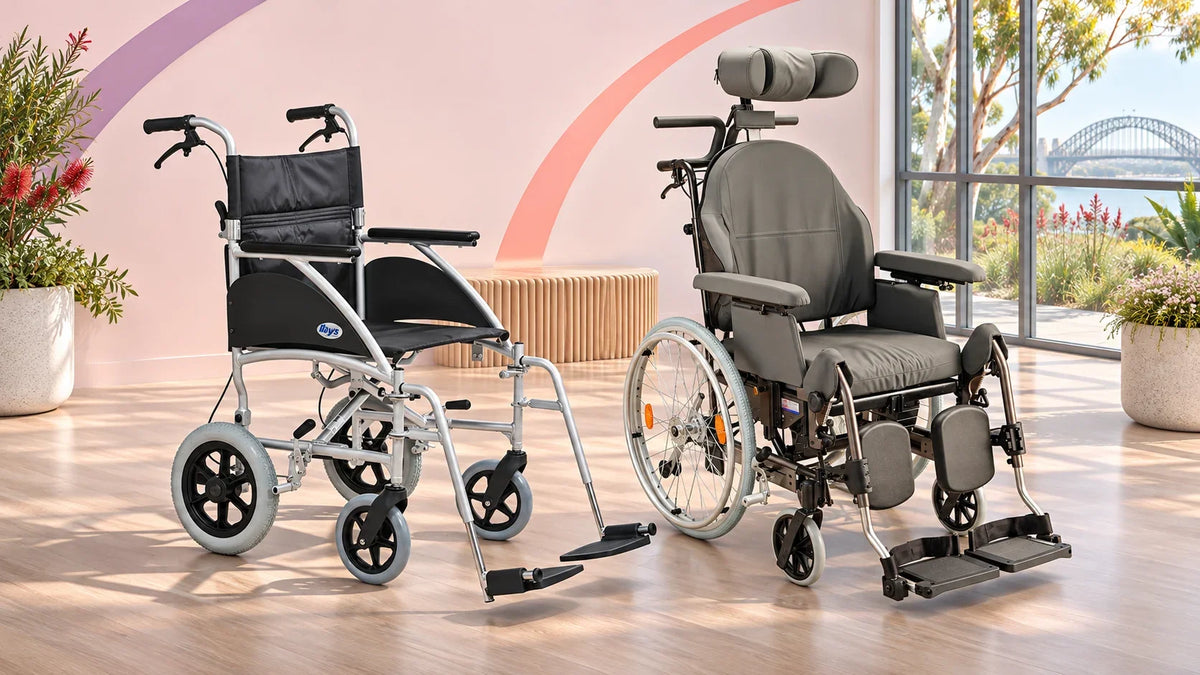
Transit and self-propelled wheelchairs are both manual wheelchairs, but their rear wheels and intended propulsion are different. A transit wheelchair has smaller rear wheels and is mainly pushed by an attendant. A self-propelled wheelchair has larger rear wheels with handrims so a suitable user can drive the chair.
Quick answer: choose a transit chair when reliable attendant propulsion and a compact folded package are the priorities. Consider a self-propelled chair when the user can safely and efficiently use the handrims and wants more control over everyday movement. Seat fit, route and transport still matter in both cases.
Use this guide while browsing AATC’s manual wheelchair collection.
The visible difference is the rear wheel
| Feature | Transit wheelchair | Self-propelled wheelchair |
|---|---|---|
| Rear wheels | Smaller wheels, commonly around 12–16 inches | Larger wheels, commonly around 22–24 inches |
| Handrims | Usually absent | Fitted so the user can push the wheels |
| Main propulsion | Attendant | User, with attendant assistance possible on many models |
| Attendant brakes | Common and important for speed control and parking | May have attendant brakes in addition to user parking brakes |
| Overall width | Often narrower because the rear wheels do not project as far | Often wider across the large rear wheels and handrims |
| Transport | Can be compact and light, depending on the model | Quick-release rear wheels can reduce transport size and lift |
The terms describe propulsion configuration, not the level of seating support. Both transit and self-propelled chairs can range from simple folding models to complex tilt-in-space and reclining systems.

Rear-wheel size and handrims are the quickest visual clues to the chair's intended propulsion.
When a transit wheelchair may suit the routine
A transit wheelchair may be appropriate when the user will be pushed for most or all trips and a consistent attendant is available. Smaller rear wheels can reduce overall width and make the chair easier to store or load in some vehicles.
Questions to check include:
- Who will push the chair during every normal trip?
- Can that person control the chair on the actual slopes and surfaces?
- Are attendant brakes fitted and easy to use?
- Can the attendant manage kerbs using the stepper tube and correct technique?
- Can the chair be folded and lifted without unsafe handling?
- What happens if the usual attendant is unavailable?
The Days Swift Transit Wheelchair is a straightforward example. Its live product specification lists 12-inch solid rear wheels, attendant hand and parking brakes, an 11.6 kg net weight and a 115 kg maximum user weight.
When a self-propelled wheelchair may suit the routine
A self-propelled wheelchair may suit a user who can reach and control the handrims, manage braking and maintain the required effort. It can offer more independence for small adjustments at a table, moving around the home or travelling longer distances.
Self-propulsion should be trialled. Shoulder movement, strength, grip, pain, endurance, sensation, coordination and the user’s posture all affect efficiency. The rear-wheel position, axle setup, tyres and chair weight also matter. A poorly configured chair can be difficult to push even when the user appears strong enough.
Compare independence and support honestly
Large rear wheels do not guarantee independent mobility. Some users may self-propel on level indoor surfaces but need help on carpet, ramps or community routes. Others may use foot propulsion or a mixed technique that changes the required seat height and setup.
Likewise, a transit chair can support community access when a skilled attendant is consistently available. The decision should reflect what happens on an ordinary day, including fatigue and changes in support.
Brakes and safe control
Manual wheelchairs can have different brake systems:
- Parking brakes: hold the rear wheels for transfers and stationary tasks; they are not normally used to slow a moving chair.
- Attendant cable or drum brakes: allow the person pushing to reduce speed and control the chair.
- Handrim control: allows a self-propelling user to slow and steer, but requires skill and suitable hand function.
Confirm who can reach each brake, the force required and whether the brake still holds correctly after tyre wear or adjustment. Lock the chair as instructed before transfers.
Width, turning and access
A self-propelled chair is commonly wider across its rear wheels and handrims. Measure the complete overall width, not only the seat width. A transit chair may pass through a narrower doorway, but footplates, armrests and the turning space can still limit access.
Measure doorways, lifts, bathroom turns and bedside space. Consider the attendant’s hands and body position behind the chair as well as the wheelchair itself.
Like-for-like example: BREEZY Relax
The live AATC range includes transit and self-propelled versions of the BREEZY Relax. Both are tilt-and-recline wheelchairs with a 140 kg maximum user weight and complex seating features, but their rear-wheel configurations change the propulsion method.
| Specification | BREEZY Relax Transit | BREEZY Relax Self-Propelled |
|---|---|---|
| Rear wheel | 16-inch solid | 24-inch solid with handrim access |
| Propulsion | Attendant | User self-propulsion, with attendant support possible |
| Braking | Attendant drum brakes | Configuration should be confirmed for user and attendant needs |
| Seat widths | 460 mm or 510 mm | 460 mm or 510 mm |
| Net product weight | 22 kg | 22 kg |
Compare the BREEZY Relax Transit and BREEZY Relax Self-Propelled. This example shows that propulsion type can change while the seating system remains similar.

Consider both everyday propulsion and the complete vehicle-loading routine.
Transport and lifting
Transit chairs are often marketed as compact, but compare exact weights. A self-propelled chair with quick-release rear wheels may separate into lighter pieces. Record:
- total chair weight
- weight without removable wheels and footrests
- heaviest component
- folded width, height and length
- car opening and loading lip
- who will lift and reassemble it
For occupied vehicle transport, folding size is not enough. Confirm whether the chair is approved for the intended transport arrangement, identify tie-down points and use the required occupant restraint system.
Seat fit is more important than wheel size
Check seat width, depth, height, back support, cushion, footrest length and arm support. An excessively wide seat can reduce postural support and make handrims harder to reach. A seat that is too narrow can create pressure and restrict clothing or movement.
Complex seating, pressure risk, asymmetric posture or long daily use requires an individual assessment. The World Health Organization recommends assessment, fitting, training and follow-up as part of wheelchair provision.
Trial checklist
- User can sit with suitable posture and support.
- User or attendant can propel the chair for the required route.
- Brakes are reachable and controllable by the intended person.
- Chair passes through and turns in the smallest real spaces.
- Transfers can be completed using the intended method.
- Footrests, armrests and removable wheels can be operated reliably.
- Transport and storage steps are practical.
- Representative surfaces are tested safely and within product limits.
Frequently asked questions
Can the user propel a transit wheelchair?
A transit chair does not normally have large rear handrims, so independent hand propulsion is not its intended function. Some users may move short distances with their feet, but this requires appropriate seat height and individual assessment.
Can an attendant push a self-propelled wheelchair?
Many self-propelled models have push handles and can be attendant-assisted. Confirm the handle height, attendant brakes and route requirements.
Is a transit wheelchair lighter?
Often, but not always. Complex transit chairs can weigh more than simple self-propelled chairs. Compare the exact total and heaviest lift.
Which is better for narrow doorways?
Transit configurations are often narrower across the rear wheels. Measure the exact overall width and turning space because seat width and frame design also vary.
Choose the propulsion arrangement first
Decide who will move the chair on the real route, then compare seat fit, brakes, width and transport. Browse manual wheelchairs, see the broader wheelchair range, or read Manual vs Electric Wheelchairs.