


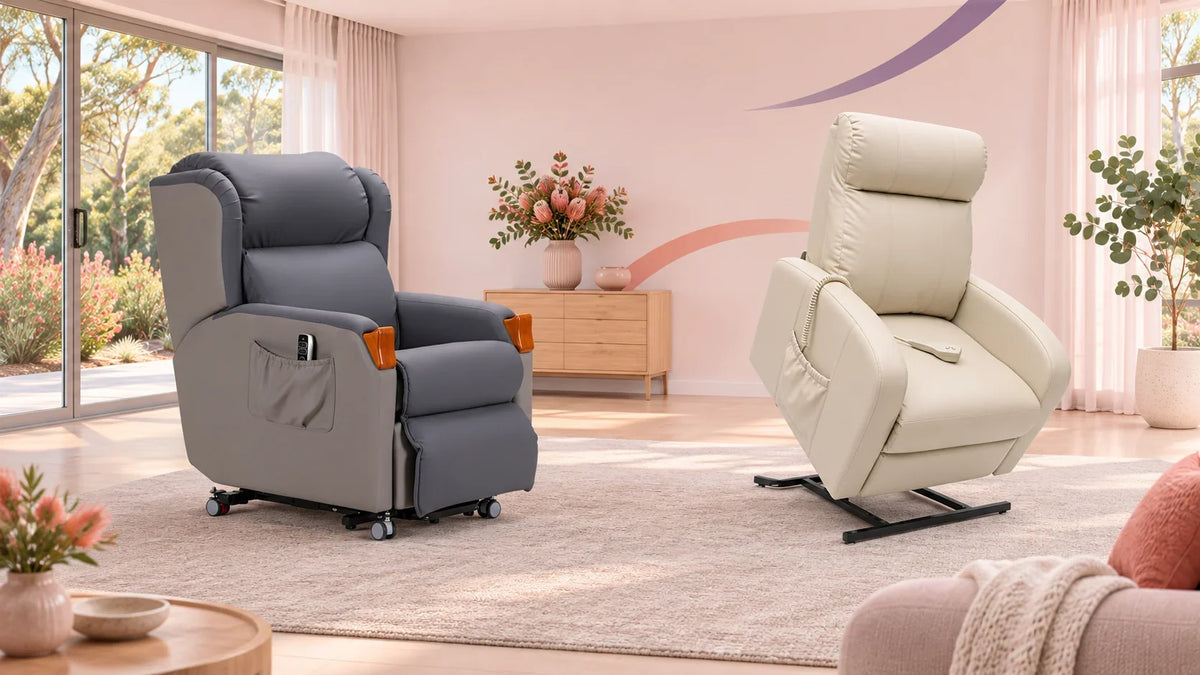
Quick answer: Choose a lift chair by matching the seat to the person, confirming the lift movement supports a controlled transfer, and checking that the chair fits the room. Seat height, width and depth matter before upholstery, colour or the number of motors. The safest decision comes from trialling the actual model in the position and footwear normally used.
A power lift chair is a recliner that raises and tilts the seat to reduce the effort needed to move between sitting and standing. It can improve independence for some ambulant users, but it does not make every transfer safe. If standing balance, strength, cognition, pain or mobility has changed, involve an occupational therapist or physiotherapist.
Start with the transfer—not the recline
Watch the complete sequence: approaching the chair, turning, sitting with control, positioning the feet, using the handset, standing and moving away. A lift chair should help the user reach a stable standing position rather than tipping them forward before their feet and walking aid are ready.
EnableNSW transfer criteria use a practical benchmark: a suitable trial should demonstrate a safe and independent transfer, with or without supervision. That principle is useful even when buying privately. If a person cannot safely stand from an appropriately high armchair, a clinical assessment can identify whether a lift chair, a different transfer aid or a change in technique is more appropriate.
Seat height affects both sitting and standing
When the chair is fully down, the user should be able to sit with their feet supported and their pelvis well back. A seat that is too high may leave the feet unsupported; one that is too low can increase the effort of standing and make the lift movement feel abrupt.
Measure the person’s lower-leg length in their usual footwear and compare it with the published floor-to-seat height. Then trial it—soft cushions compress, posture varies and a measurement alone cannot confirm fit.
Seat width and depth shape posture
- Width: allow comfortable clearance without leaving so much space that the user loses lateral support or leans.
- Depth: the user should sit back against the backrest without the front edge pressing behind the knees.
- Arm height: forearms should rest comfortably and the arms should provide a useful surface during transfers.
- Back and head support: check support in upright, reclined and lift positions—not only when the chair is stationary in a showroom.

Chair fit and full movement clearance should be checked before colour or upholstery.
Compare motors by movement, not marketing
On many single-motor chairs, the backrest and leg rest move in a linked sequence. Dual-motor models usually offer more independent adjustment between the back and legs. Some chairs use additional motors for head, lumbar or tilt functions. The exact sequence varies, so always check the handset and manual for the specific model.
More motors can provide positioning flexibility, but they also add buttons and possible combinations. A simple control may be easier for someone with reduced vision, hand function or memory. Choose the movement the person can understand and use consistently.
Check the room through the chair’s full movement
Measure the chair’s overall width and depth, then allow clearance for full recline and lift. Include skirting boards, side tables, curtains, heaters and the walking route. A wall-saver mechanism may reduce the rear clearance needed, but it does not remove the need to follow the manufacturer’s specified space.
Keep the power cable away from walking paths and moving mechanisms. Confirm access to a suitable power outlet and whether the model has a battery-backup option. Backup systems are for controlled operation during a power interruption; follow the manual for battery type and replacement.
Upholstery, temperature and cleaning
Fabric, vinyl and leather-like finishes feel different against the skin and have different cleaning requirements. Consider continence, spills, pets, heat, friction and whether covers or cushions can be removed. A “pressure care” description does not mean pressure risk has been eliminated. People with skin-integrity or positioning concerns need clinical advice.
Use current product specifications
The KCare Air Comfort Compact Lift Chair Dual Motor illustrates why selecting the correct size matters. The live AATC listing offers small, medium and large variants with a published maximum user weight of 140 kg. Listed seat depths vary from 440 to 510 mm and the large version has a wider seat than the small and medium versions. It also lists independent backrest and footrest adjustment and a wall-saver mechanism.
The Pride Mobility C-101 Lift Chair is a single-motor example. Product names such as “three-position” or “dual motor” do not replace checking the current size, movement sequence, capacity and manual for the exact variant being considered.

Trial upright, preferred recline and lift positions—the complete sequence matters.
Lift-chair trial checklist
- Wear normal footwear and bring the walking aid normally used after standing.
- Confirm the user can approach, turn and sit without catching the footrest or cable.
- Check feet, thighs, pelvis, back, head and arms in the fully seated position.
- Operate every handset button and confirm the symbols and sequence are understood.
- Trial the lift slowly and stop at the point where the user can stand with control.
- Test the preferred reading, resting and leg-elevation positions.
- Measure full recline and lift clearance in the intended room.
- Confirm the user and carer understand power, emergency and cleaning instructions.
Frequently asked questions
Does a lift chair help everyone stand safely?
No. It assists the movement, but the user still needs an appropriate transfer plan, foot placement and enough balance to move away safely. Some people need supervision or different equipment.
Should my feet touch the floor?
In the normal seated position, supported feet are an important fit check. Trial the actual cushion because its compression affects the effective seat height.
Is a larger lift chair more comfortable?
Not automatically. Excess width or depth can reduce support and encourage sliding or leaning. Choose the size that fits the person.
Can a lift chair replace a pressure care plan?
No. Recline and upholstery may assist comfort or positioning, but pressure care still requires individual assessment, skin monitoring and movement strategies.
Next step: Browse AATC’s lift chairs, shortlist models whose dimensions match the user and room, then arrange a realistic trial before deciding.
Sources and further reading
- EnableNSW: Transfer Equipment Funding Criteria
- EnableNSW: Power Lift Chair Equipment Request Form
- Queensland Spinal Cord Injuries Service: skin considerations for seating
This article provides general information and does not replace individual clinical advice, a transfer assessment or the product manual.