


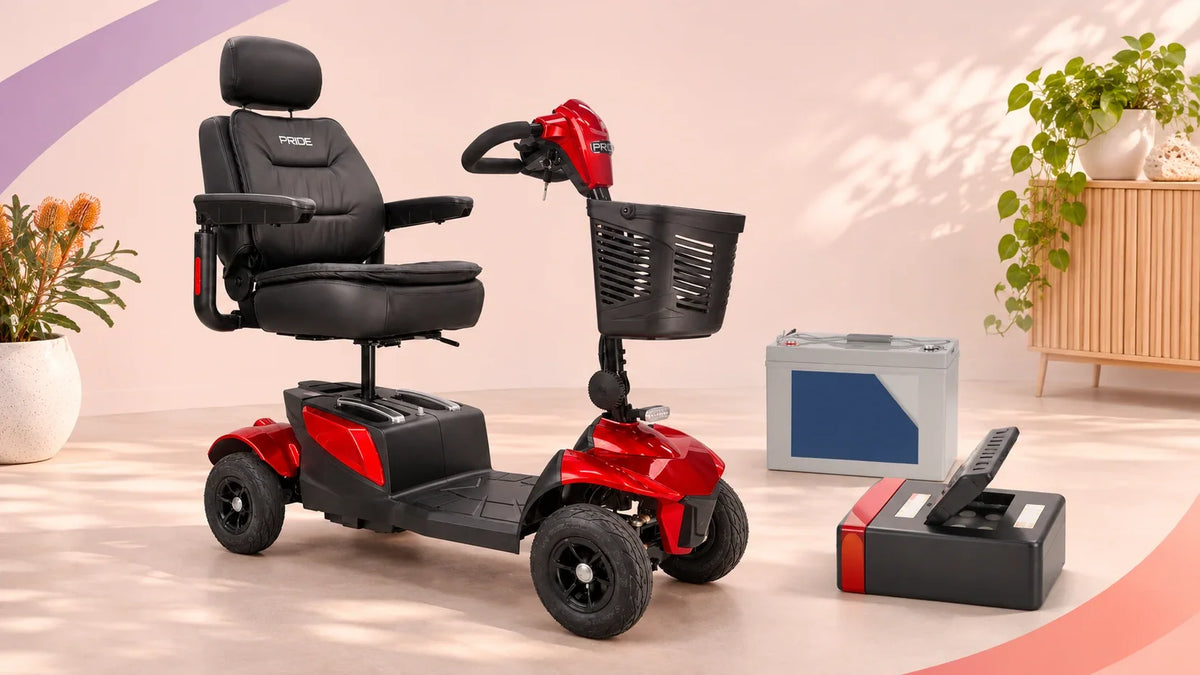
Mobility scooter range is usually presented as a maximum distance per charge. It is useful for comparing models, but it is not a promise that every trip will achieve the same number. Battery type, battery condition, user weight, hills, surfaces, tyre pressure, temperature and repeated stopping can all change the distance available.
Quick answer: choose a scooter with a practical range buffer beyond the normal return trip, identify the exact battery chemistry and capacity, and follow the charging instructions for that model. Replace batteries only with a compatible type, voltage, capacity, connector and charger approved for the scooter.
Browse the current mobility scooter range and mobility scooter batteries while using this guide to record the specifications that matter.
Published range versus real-world range
A published range is measured under defined test conditions. Everyday use rarely matches those conditions exactly. Treat the figure as a comparison point and plan around the most demanding normal route.
Real-world range can be reduced by:
- higher combined weight from the user, shopping and accessories
- hills, driveway gradients and repeated kerb crossings
- soft ground, grass, gravel or uneven footpaths
- frequent acceleration, stopping and tight manoeuvring
- cold or very hot conditions
- under-inflated pneumatic tyres or increased rolling resistance
- an ageing, damaged or incompletely charged battery
- lights, powered seating or other electrical accessories
Start with the full return-trip distance, add a practical reserve and consider whether an unexpected detour or missed charging opportunity is realistic. If the scooter is essential for long community trips, discuss the reserve with the supplier rather than selecting a battery from the advertised distance alone.

Hills, surfaces, load and riding conditions can all change real-world range.
What voltage, amp-hours and watt-hours mean
| Measurement | What it describes | Why it matters |
|---|---|---|
| Voltage (V) | The electrical system voltage | The replacement battery and charger must match the scooter’s required system |
| Amp-hours (Ah) | A capacity rating under specified conditions | Higher Ah can indicate more stored energy within the same voltage and chemistry, but it does not by itself guarantee range |
| Watt-hours (Wh) | Voltage multiplied by amp-hours | Useful for comparing stored energy and for airline documentation |
A 24V 10Ah battery has a nominal energy rating of 240Wh. Two 12V batteries may be connected in series to form a 24V system, but that does not mean any two 12V batteries are suitable. Chemistry, capacity, physical dimensions, terminals, wiring, charger profile and manufacturer approval must also match.
Sealed lead-acid, gel and lithium batteries
Sealed lead-acid and gel batteries
Many mid-size and larger scooters use sealed lead-acid batteries, including gel or AGM variants. They are commonly installed as a matched pair. They are generally heavier than lithium batteries and use a charger designed for their chemistry and voltage.
Do not mix an old battery with a new battery in a paired set unless the manufacturer specifically permits it. A mismatched pair can charge and discharge unevenly. Confirm whether replacement should be completed as a pair.
Lithium-ion batteries
Lithium batteries can reduce weight and are common in folding and portable scooters. A removable pack may allow off-board charging, but only when the product instructions support it. Lithium packs require the correct battery-management system and approved charger.
Fire and Rescue NSW advises using the charger supplied with the device or compatible certified charging equipment. Stop using or charging a lithium battery that is swollen, leaking, unusually hot, damaged, wet or producing an unusual smell or sound.
How scooter specifications work together
The Pride Mobility Gopher Eco provides a useful example. Its live product specification lists a maximum range of up to 36 km and a battery requirement of two 31Ah batteries. The same page also lists a 150 kg user capacity, pneumatic tyres and front and rear suspension. Range should be considered with the complete scooter, route and load rather than the battery number in isolation.
The Spare Solax Battery is a different format: a 24V 10Ah lithium pack weighing 1.7 kg for specified Solax models. It demonstrates why a portable scooter battery cannot be compared directly with a pair of larger gel batteries using amp-hours alone.
A practical charging routine
- Park the scooter in a dry, ventilated area away from exits and combustible materials.
- Switch the scooter off and follow the connection order in the user manual.
- Use only the charger supplied or approved for the exact battery and scooter.
- Check cables, plugs and the charging socket for damage before use.
- Allow the charger to complete its normal cycle as described by the manufacturer.
- Disconnect it according to the manual when charging is complete.
- Do not drive the scooter while it is connected to the charger.
Charging instructions vary. Pride Mobility advises charging sealed lead-acid batteries after use and not storing them empty. Lithium battery guidance may be different. The scooter and battery manual always takes priority over a general rule.

Use the correct charger and keep the charging area dry, clear and ventilated.
Charging and storage safety
- Do not use a charger merely because its plug fits.
- Do not cover the charger or place it on a soft combustible surface.
- Keep the charging route clear so cables do not create a trip hazard.
- Do not charge a visibly damaged, swollen, leaking or overheating battery.
- Follow the manufacturer’s temperature and ventilation limits.
- Keep batteries and terminals dry and protected from impact.
- Arrange professional inspection when a fault, unusual heat or repeated charging failure occurs.
For long-term storage, follow the manual’s recharge schedule. Do not assume a scooter can be left with an empty battery for several months. Storage temperature, charger connection and recharge frequency depend on the battery type and product instructions.
Why the battery gauge can change during a trip
A dashboard gauge is an estimate. The displayed level can fall under load on a hill and recover slightly when the scooter stops. Learn how the specific gauge behaves rather than treating each segment as an exact distance.
Record the route, weather, load and gauge behaviour when assessing a change in range. A sudden reduction can have several causes, including battery age, a charging fault, tyre condition, brake drag or an electrical issue. Avoid diagnosing it from the dashboard alone.
When replacement may need investigation
Arrange a battery and scooter check when:
- the scooter covers substantially less distance on the same route
- the charger does not reach its normal completed state
- the battery gauge drops rapidly under ordinary load
- the scooter slows or cuts out unexpectedly
- the case, terminals, cables or connectors are damaged
- a lithium battery becomes hot, swollen, wet, leaking or produces an unusual odour
Battery age alone does not confirm the cause. The charger, wiring and scooter should be considered before buying a replacement.
Replacement battery checklist
- Exact scooter brand and model
- Battery chemistry
- Required voltage and number of batteries
- Amp-hour capacity permitted by the manufacturer
- Physical dimensions and orientation
- Terminal type, polarity and connector
- Compatible charger model and output
- Battery weight and removal process
- Any airline documentation required for travel
A battery page can contain naming or specification errors, and product revisions can change. Confirm the current label, manual and supplier compatibility before ordering. Installation should be completed by a competent person following the manufacturer’s procedure.
Frequently asked questions
How far can a mobility scooter travel on one charge?
It depends on the model, battery and conditions. Use the published range as a comparison figure, then allow for hills, load, surface, temperature, tyre condition and battery age. Plan a reserve beyond the normal return trip.
Should I charge my mobility scooter after every use?
Many sealed lead-acid scooter manuals recommend charging after use, while lithium products may have different instructions. Follow the exact scooter and battery manual.
Can I use a higher amp-hour battery?
Only when the manufacturer confirms compatibility. Physical space, battery chemistry, charger profile, wiring and weight can make a higher-capacity battery unsuitable even when voltage matches.
Can I leave the charger connected overnight?
Follow the product manual and current fire-safety guidance. Do not leave damaged lithium equipment charging, do not charge where it blocks an exit and use only the approved charger.
Can I take a scooter battery on a plane?
Airline approval and packing instructions depend on chemistry, watt-hours, removability and the complete mobility aid. Contact the airline before travel and carry the manufacturer’s battery documentation. See the portable and folding scooter guide for a travel checklist.
Plan range around the route, not the brochure maximum
Start with the real return trip, add a reserve and confirm how the exact battery should be charged and stored. Browse mobility scooter batteries, compare the full mobility scooter range, or read How to Choose a Mobility Scooter in Australia.