


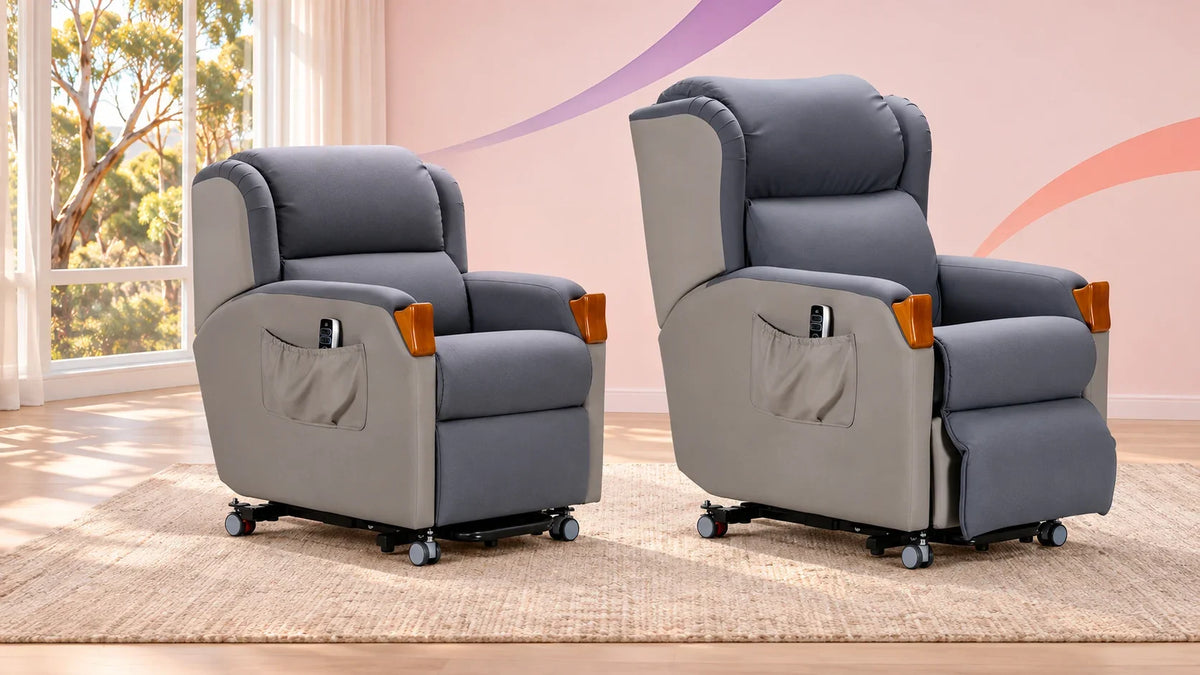
Quick answer: A single-motor lift chair usually moves the backrest and leg rest in a linked sequence. A dual-motor chair usually lets the backrest and leg rest adjust more independently. Dual motor can provide more positioning choices; single motor can provide a simpler control experience. Fit, transfer safety and the actual movement of the selected model matter more than the label alone.
| Consideration | Single motor | Dual motor |
|---|---|---|
| Back and leg movement | Usually linked or sequenced | Usually more independent |
| Handset | Often fewer buttons | Often more buttons and combinations |
| Positioning range | Good for straightforward lift and recline | More flexibility for back angle and leg elevation |
| Ease of learning | May be simpler | Requires understanding separate controls |
| Best choice | Depends on fit, function, transfer trial, room and user preference | |
How a single-motor lift chair usually works
One motor drives the main lift-and-recline sequence. As the chair reclines, the footrest and backrest generally move together according to the chair’s mechanism. That coordinated movement can be easy to understand and repeat.
Single motor does not mean “basic” or unsuitable. A well-fitted single-motor chair can be the better option when the user prefers fewer controls and the available positions meet their needs. The exact movement varies between models, so trial it rather than relying on a category description.
How a dual-motor lift chair usually works
Dual motor commonly allows the backrest to recline separately from the leg rest. This can make it possible to elevate the legs while keeping a more upright back, or recline the back without using the maximum leg position. The handset normally has additional buttons to control those movements.
Independent adjustment may help a person find a preferred resting, reading or leg-elevation position. It can also create more choices than some users want. Vision, grip, sensation, cognition and the ability to recognise handset symbols should be part of the decision.

Single-motor movement is commonly linked; dual motor usually provides more independent adjustment.
The number of motors does not determine fit
Motor configuration cannot correct a seat that is too high, wide or deep. Check floor-to-seat height, usable seat width, seat depth, back height, arm support and maximum user weight for the exact size. The user should sit with supported feet and be able to stand at the appropriate point in the lift cycle without being pushed forward.
Compare the transfer sequence
Both types should be trialled from approach to departure. Position the usual walking aid safely, operate the lift slowly, and stop when the user can establish balance. EnableNSW guidance for power lift chairs emphasises that a trial should demonstrate a safe and independent transfer, with or without supervision.
Do not use the handset to raise someone who cannot maintain the required standing balance or transfer safely. A therapist can assess whether the lift chair is the right category of equipment.
Positioning and leg elevation
A dual motor can offer useful separation between trunk angle and leg elevation, but the desired position must still be comfortable and clinically appropriate. Reclining the back is not the same as tilt-in-space and may allow the body to slide if the fit is poor. For oedema, pain, respiratory or pressure concerns, seek advice about the position rather than selecting by motor count alone.
Controls, power and backup
- Can the user identify and press each button reliably?
- Is the cable routed away from feet and moving parts?
- Does the chair stop immediately when the button is released?
- Is there a backup-battery facility, and is it maintained as instructed?
- Can a carer return the chair to a safe position if the user becomes confused?

More positioning choices also mean more controls to understand and use consistently.
Same-family product example
The KCare Air Comfort Compact Lift Chair provides electric lift, sit and recline functions in small, medium and large sizes. Its live listing includes a wall-saver mechanism and backup-battery capability.
The KCare Air Comfort Compact Lift Chair Dual Motor adds independent backrest and footrest adjustment. It is also offered in small, medium and large variants and lists a 140 kg maximum user weight. Using models from the same family makes the functional distinction easier to see, but the dimensions for the chosen size still need to be checked.
Which type may suit which priority?
- Consider single motor when a straightforward linked recline meets the need and simpler controls are valuable.
- Consider dual motor when independent back and leg positions are useful and the user can manage the extra controls.
- Consider professional assessment when the chair is needed for pressure management, oedema, complex posture, pain, high falls risk or assisted transfers.
Questions to answer during a trial
- Can the user sit fully back with feet supported?
- Can they operate the handset without looking at it for long periods?
- Does the lift stop at a stable, repeatable transfer point?
- Can they achieve their normal activities without an uncomfortable back or knee angle?
- Does the chair clear the wall, furniture and walking route in every position?
- Can the user return the chair to a neutral position reliably?
Frequently asked questions
Is dual motor always better?
No. It offers more adjustment, but the best chair is the one that fits and can be used safely. Some users prefer the simplicity of a single motor.
Does dual motor mean the chair lifts faster?
Not necessarily. Motor count describes functions, not lift speed. Check the actual model.
Can both types lift a person to standing?
Both categories can include a lift function. The transfer still needs to be safe for the individual.
What about triple- or four-motor chairs?
Additional motors may control head, lumbar or other positioning functions. Compare the specific movements and controls rather than assuming more motors are required.
Next step: Compare AATC’s single-motor lift chairs and dual-motor lift chairs, then trial the shortlisted model and size.
Sources and further reading
This article provides general information and does not replace individual clinical advice, a transfer assessment or the product manual.